When couples receive a medical recommendation to pursue In Vitro Fertilization (IVF), their primary concern after cost is almost universally: "What is the success rate of IVF in India?"
Infertility is an emotionally demanding medical jouey. Knowing realistic statistical odds helps intended parents approach treatment with confidence, clarity, and balanced expectations. Across premier fertility centers in India, the clinical pregnancy rate for a single fresh or frozen embryo transfer in women under 35 years typically ranges between 55% and 70%. When advanced laboratory technologies such as blastocyst culture, ICSI, and cumulative multiple embryo transfers are utilized, overall live birth success rates can reach 80% to 90% across 2 to 3 treatment cycles.
However, IVF success is never a single monolithic statistic. It is deeply personal and influenced by mateal age, biological ovarian reserve (Low AMH), pateal sperm DNA integrity, uterine endometrial receptivity, and the technological standards of the embryology laboratory.
In this clinical guide, senior reproductive endocrinologists and chief embryologists at Progenesis Fertility Center examine the realistic benchmarks of IVF success in India, providing age-wise statistical breakdowns, single-cycle versus cumulative probabilities, and evidence-based strategies to optimize your chances of conceiving.
National IVF Success Rate Benchmarks in India at a Glance
To understand national standards, it is essential to distinguish between Clinical Pregnancy Rate (the presence of a gestational sac with fetal heartbeat detected via ultrasound at 6–7 weeks) and Live Birth Rate (the successful delivery of a healthy newborn).
| Clinical Metric / Parameter | National Industry Average (India) | Leading Centers (Progenesis Advanced ART Protocols) |
|---|---|---|
| Average Clinical Pregnancy Rate (<35 Years) | 50% – 60% | 70% – 75% |
| Clinical Pregnancy Rate (35–37 Years) | 40% – 48% | 55% – 62% |
| Clinical Pregnancy Rate (38–40 Years) | 25% – 35% | 40% – 48% |
| Clinical Pregnancy Rate (>40 Years, Self Egg) | 10% – 18% | 20% – 28% |
| Donor Egg IVF Success Rate (All Ages) | 60% – 70% | 75% – 82% |
| Cumulative Live Birth Rate (3 Consecutive Cycles) | 70% – 75% | 85% – 90% |
| Blastocyst (Day 5) Implantation Rate | 45% – 52% | 65% – 72% |
Note: Benchmarks reflect standardized clinical registries and certified Indian Council of Medical Research (ICMR) & ART Act guidelines.
Also Read: What is the Cost of IVF in India? Complete Pricing & Inclusions Guide
Age-Wise IVF Success Rate Matrix: How Age Impacts Your Odds
Mateal age remains the single most decisive biological determinant of IVF success when using self eggs. A woman is born with all the eggs she will ever possess. As time progresses, both the quantity (antral follicle count and AMH levels) and genetic quality of those eggs decline naturally.
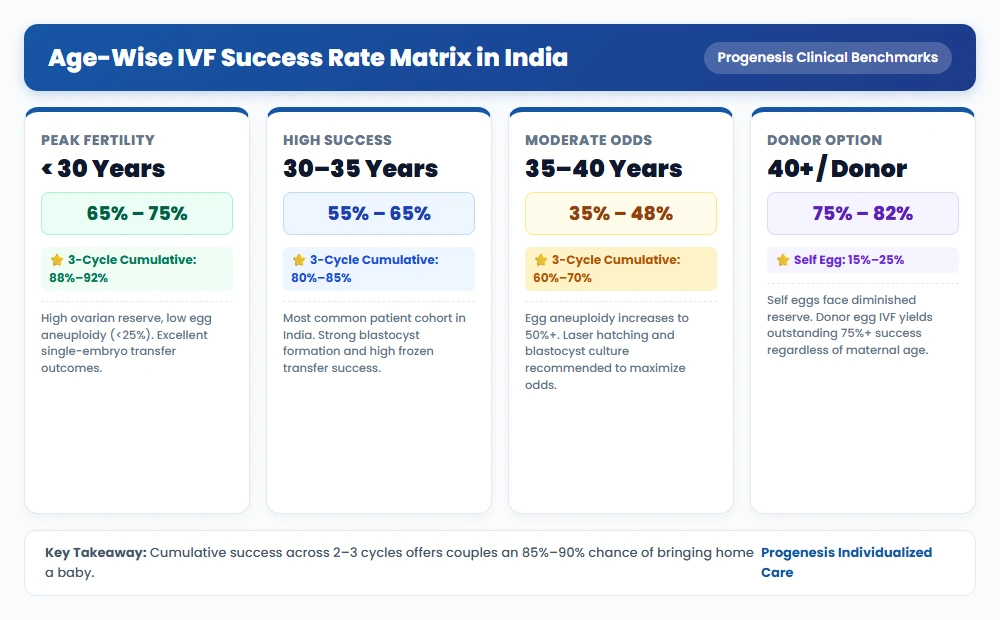
1. Age Under 30 Years (Peak Reproductive Window)
- Success Rate Per Transfer: 65% – 75%
- Cumulative Success Across 3 Cycles: 88% – 92%
- Clinical Profile: Women in this age bracket produce higher numbers of mature, high-grade oocytes with low chromosomal aneuploidy rates (typically under 25%). Consequently, embryos show high blastocyst formation and robust implantation rates.
2. Age 30 to 35 Years (High Success Window)
- Success Rate Per Transfer: 55% – 65%
- Cumulative Success Across 3 Cycles: 80% – 85%
- Clinical Profile: This is the most common demographic presenting for assisted reproduction in India. While ovarian reserve may show slight natural attrition, egg quality remains very strong. Blastocyst culture combined with frozen embryo transfer yields excellent outcomes.
3. Age 35 to 37 Years (Gradual Decline)
- Success Rate Per Transfer: 42% – 52%
- Cumulative Success Across 3 Cycles: 65% – 75%
- Clinical Profile: At age 35, the rate of chromosomal abnormalities in eggs increases to approximately 40%–50%. Personalized stimulation protocols, gentle gonadotropin dosing, and Day-5 blastocyst culture are essential to select genetically competent embryos.
4. Age 38 to 40 Years (Steep Decline)
- Success Rate Per Transfer: 25% – 35%
- Cumulative Success Across 3 Cycles: 45% – 55%
- Clinical Profile: Women in this age group experience accelerated follicular depletion and lower AMH levels. Chromosomal aneuploidies exceed 60%. Utilizing advanced techniques such as Laser-Assisted Hatching (LAH) and Preimplantation Genetic Testing (PGT-A) significantly reduces miscarriage risks and improves transfer efficiency.
5. Age 40 to 42 Years (Low Self-Egg Reserve)
- Success Rate Per Transfer: 15% – 22%
- Cumulative Success Across 3 Cycles: 30% – 40%
- Clinical Profile: High rates of cycle cancellation or low egg yield. Sequential stimulation cycles (embryo pooling) or consideration of donor oocytes are often discussed to maximize live birth probabilities.
6. Age Above 42 Years
- Self-Egg Success Rate Per Transfer: 5% – 12%
- Donor-Egg Success Rate: 75% – 82%
- Clinical Profile: Less than 10%–15% of retrieved eggs are chromosomally normal. For women above 42 who desire high certainty of a healthy pregnancy, donor egg IVF offers exceptional success rates regardless of mateal age because donor eggs are retrieved from young, healthy, prescreened donors.
Detailed Age-Wise IVF Performance Breakdown
| Age Group | Single Transfer Pregnancy Rate | Miscarriage Risk Rate | Recommended Embryo Stage | Advanced ART Recommendations |
|---|---|---|---|---|
| < 30 Years | 65% – 75% | 10% – 12% | Day 5 Blastocyst | Standard IVF / ICSI, Single Embryo Transfer (eSET). |
| 30 – 35 Years | 55% – 65% | 13% – 18% | Day 5 Blastocyst | ICSI, Frozen Embryo Transfer (FET). |
| 35 – 37 Years | 42% – 52% | 20% – 25% | Day 5 Blastocyst | Dual trigger stimulation, Laser-Assisted Hatching. |
| 38 – 40 Years | 25% – 35% | 30% – 38% | Day 5 Blastocyst (with PGT-A) | PGT-A Genetic Screening, Embryo Pooling, LAH. |
| 40 – 42 Years | 15% – 22% | 40% – 50% | PGT-A Screened Blastocyst | Embryo batching, PRP endometrial rejuvenation. |
| > 42 Years (Self) | 5% – 12% | > 55% | Screened Blastocyst / Pooling | Mild stimulation pooling or Donor Egg Program. |
| Any Age (Donor Eggs) | 75% – 82% | 10% – 14% | Day 5 High-Grade Blastocyst | Complete endometrial receptivity preparation. |
Also Read: How Many Days Does Sperm Live in the Female Body? Conception Guide
Single Cycle vs. Cumulative Success Rate: The True Picture of IVF
One of the most frequent points of confusion among fertility patients is comparing "single-cycle success" with "cumulative success":
┌────────────────────────────────────────────────────────┐ │ SINGLE CYCLE VS CUMULATIVE IVF SUCCESS │ └──────────────────────────┬─────────────────────────────┘ │ ┌────────────────────┴────────────────────┐ ▼ ▼ ┌────────────────────────┐ ┌────────────────────────┐ │ SINGLE CYCLE SUCCESS │ │ CUMULATIVE SUCCESS │ ├────────────────────────┤ ├────────────────────────┤ │ • One egg retrieval & │ │ • All fresh + frozen │ │ one embryo transfer │ │ transfers from 1–3 │ │ • Success: 50% – 65% │ │ stimulation cycles │ │ • 1 in 3 couples need │ │ • Success: 80% – 90% │ │ a second attempt │ │ • Highest real odds │ └────────────────────────┘ └────────────────────────┘ - Why the First Cycle May Not Always Succeed:
Human reproduction is naturally inefficient; even fertile 20-year-old couples have only a 20% to 25% chance of conceiving in any given month. An unsuccessful first IVF transfer does not indicate treatment failure—it often provides critical diagnostic insights regarding how an individual's ovaries respond to medications and how embryos develop in culture. - Cumulative Success Rate (The Gold Standard):
When multiple healthy blastocysts are created from an egg retrieval, surplus embryos are vitrified (frozen). If the first transfer does not implant, the couple undergoes a subsequent Frozen Embryo Transfer (FET) without needing repeat ovarian stimulation or surgery. By cycle 2 or 3, cumulative pregnancy rates reach 85% to 90%.
4 Key Pillars That Determine IVF Success
IVF success is goveed by a delicate interplay of mateal biology, pateal factors, and clinical embryology precision:
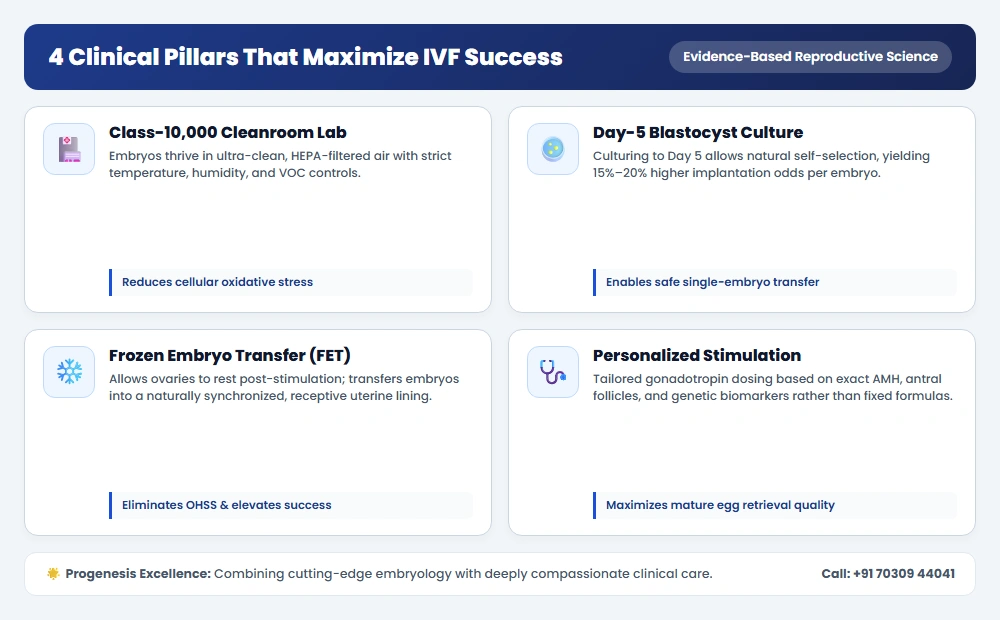
1. Embryo Quality & Blastocyst Stage
Embryos cultured to Day 5 (Blastocyst Stage) possess between 100 to 200 cells divided into the inner cell mass (which becomes the fetus) and the trophectoderm (which becomes the placenta). Transferring a Day-5 blastocyst increases implantation rates by 15% to 20% compared to Day-3 cleavage-stage embryos because weaker embryos arrest between Days 3 and 5, filtering out non-viable candidates.
2. Endometrial Receptivity & Thickness
Even a genetically flawless embryo cannot implant without a receptive uterine environment:
* An optimal endometrial thickness of 7mm to 12mm with a distinct triple-line (trilaminar) pattern on ultrasound on the day of progesterone exposure provides the highest clinical pregnancy rates.
* Conditions like intrauterine adhesions (Asherman's syndrome), endometrial polyps, submucosal fibroids, or bulky uterus / adenomyosis must be diagnosed and treated prior to transfer.
3. Male Factor & Sperm DNA Fragmentation
Over 40% of all infertility cases involve a male factor. While standard semen analysis assesses count and motility, high Sperm DNA Fragmentation Index (DFI > 25%–30%) significantly impairs blastocyst formation, doubles miscarriage risks, and causes unexplained implantation failure. Advanced sperm selection techniques such as IMSI (Intracytoplasmic Morphologically-selected Sperm Injection) or microfluidic sperm sorting overcome severe pateal barriers.
4. Embryology Cleanroom & Lab Standards
An IVF clinic's success is directly bounded by its laboratory environment. Developing embryos lack an immune system and are acutely sensitive to airboe toxins, volatile organic compounds (VOCs), and temperature shifts:
* Class-10,000 Modular Cleanrooms: Ensure ultra-clean, HEPA-filtered positive-pressure air environments.
* Benchtop Tri-Gas Incubators: Provide individual chambers with reduced oxygen (5% O2) and physiological carbon dioxide levels, mirroring the human fallopian tube and uterus far more effectively than traditional box incubators.
Fresh vs. Frozen Embryo Transfer (FET): Which Yields Higher Success?
Over the past decade, a major shift in reproductive medicine has been the growing preference for Frozen Embryo Transfer (FET) over Fresh Embryo Transfer:
| Parameter / Outcome | Fresh Embryo Transfer | Frozen Embryo Transfer (FET) |
|---|---|---|
| Uterine Environment | High supraphysiological estrogen and progesterone levels from stimulation injections. | Natural or gently prepared hormonal environment mimicking natural cycle. |
| Endometrial Receptivity | Endometrium may advance too quickly, reducing the implantation window. | Endometrium is prepared precisely with synchronized progesterone timing. |
| Risk of OHSS | Higher risk of Ovarian Hyperstimulation Syndrome if pregnancy occurs. | Zero risk of late-onset OHSS due to "freeze-all" protocol. |
| Average Success Rate | 50% – 58% | 65% – 72% |
| Obstetric Outcomes | Slightly higher incidence of low birth weight and preterm birth. | Lower rates of ectopic pregnancy, higher average birth weights. |
At Progenesis Fertility Center, our standard protocol for women with high egg yields or PCOS is the Freeze-All strategy, which isolates egg retrieval from the transfer phase, allowing the mother's hormonal balance to normalize and significantly increasing implantation rates.
Proven Strategies to Maximize Your IVF Success Rate
While medical protocols form the foundation of success, patient preparation plays a vital supporting role:
- Optimize Your Body Mass Index (BMI): A BMI between 19 and 25 is ideal. Both underweight (BMI < 18.5) and overweight (BMI > 29) statuses interfere with hormonal absorption, follicular recruitment, and endometrial blood flow.
- Prioritize Micronutrient Support: Supplement with active folate (methylfolate), Vitamin D3 (optimal levels > 30–50 ng/mL), Coenzyme Q10 (ubiquinol 200–600 mg daily for mitochondrial egg health), and Omega-3 fatty acids for at least 60 to 90 days before ovarian stimulation.
- Eliminate Endocrine Disruptors: Smoking, vaping, alcohol consumption, and heavy caffeine intake (>200 mg/day) directly impair oocyte quality and sperm DNA integrity.
- Partner Semen Optimization: Men should avoid saunas, hot tubs, tight undergarments, and laptops on laps to prevent scrotal hyperthermia during the 72-day spermatogenesis cycle.
- Treat Chronic Uterine Inflammation: Asymptomatic chronic endometritis diagnosed via hysteroscopy or CD138 biopsy can lower implantation by 30%. A simple targeted course of antibiotics resolves this prior to embryo transfer.
Debunking Common Myths About IVF Success Rates
Myth 1: "Strict 14-day bed rest after embryo transfer increases success."
Medical Reality: False. Extensive inteational clinical trials demonstrate that prolonged bed rest does not improve implantation and may actually decrease success by reducing pelvic blood flow and increasing anxiety. Resuming normal daily light activities within 24 hours is medically recommended.
Myth 2: "If your first IVF cycle fails, IVF will never work for you."
Medical Reality: False. Over 60% of couples who do not conceive in their first cycle achieve a live birth in cycle 2 or 3. Each cycle provides invaluable diagnostic data regarding embryo kinetics, allowing specialists to refine stimulation dosages, trigger timing, and luteal support.
Myth 3: "IVF babies are physically weaker or suffer from health issues."
Medical Reality: False. Millions of children born through IVF over the past four decades are as healthy, intellectually vibrant, and physically robust as naturally conceived children. Modern ICSI and vitrification protocols carry excellent safety records.
Myth 4: "IVF always results in twins or triplets."
Medical Reality: False. Multiple gestations are not an inherent byproduct of IVF; they result from transferring multiple embryos simultaneously. With modern Day-5 blastocyst culture, responsible centers practice Elective Single Embryo Transfer (eSET), achieving 65%+ pregnancy rates while virtually eliminating the mateal and fetal complications of multiple pregnancies.
Frequently Asked Questions (FAQs) About IVF Success Rates
1. What is the success rate of IVF on the first attempt in India?
At premier fertility centers in India, the success rate of IVF on the first attempt ranges between 55% and 65% for women under 35 years using their own eggs and Day-5 blastocysts. For women aged 35 to 40, first-attempt success averages 35% to 45%.
2. Can IVF have a 100% success rate?
No medical procedure can guarantee a 100% success rate. Even with perfect chromosomal genetics and ideal uterine lining, biological implantation is a complex biochemical dialogue. However, through cumulative transfers (2 to 3 cycles) and advanced protocols like blastocyst culture and PGT-A, success rates can reach 85% to 90%.
3. How does blastocyst culture improve IVF success?
Extended blastocyst culture allows embryos to grow to Day 5 or Day 6 (100–200 cells). In nature, only genetically competent embryos survive to this stage. Transferring a blastocyst increases pregnancy odds by 15% to 20% over Day-3 cleavage embryos and allows safe single-embryo transfer.
4. Why are frozen embryo transfers (FET) more successful than fresh transfers?
During a fresh cycle, high estrogen levels from ovarian stimulation can alter endometrial receptivity. In a Frozen Embryo Transfer (FET), embryos are safely vitrified while the woman's ovaries recover. The endometrium is then prepared in a subsequent natural or hormonally synchronized cycle, resulting in 10% to 15% higher implantation rates.
5. Does low AMH mean IVF will fail?
No. Low AMH indicates a reduced quantity of eggs, not necessarily poor quality. While fewer eggs may be retrieved per cycle, women with low AMH can achieve successful pregnancies using personalized mild-stimulation protocols, dual stimulation (DuoStim), or embryo pooling.
6. What role does sperm health play in IVF success?
Sperm provides 50% of the embryo's genetic material. High sperm DNA fragmentation (DFI > 25%) leads to poor blastocyst development, higher miscarriage rates, and failed cycles. Using ICSI or IMSI ensures that only the most viable, morphologically superior sperm are selected for fertilization.
7. How does mateal age affect IVF success rates?
Mateal age is the primary factor affecting egg quality and chromosomal normality. Under age 35, success rates per transfer exceed 60%. After 35, chromosomal abnormalities naturally increase, reducing success to 40%–50% at age 35–37, 25%–35% at 38–40, and 15%–20% above 40.
8. What is the success rate of donor egg IVF in India?
Donor egg IVF offers high success rates of 75% to 82% per transfer, regardless of the recipient mother's age. This is because donor eggs are retrieved from healthy, young donors (usually under 28 years) who have undergone rigorous medical, hormonal, and genetic screening under Indian ART Act guidelines.
Conclusion: Partnering with Progenesis for Your Parenthood Dream
Understanding the statistics behind IVF is empowering. While age and medical history set the initial baseline, partnering with an experienced, patient-centric fertility clinic equipped with Class-10,000 embryology cleanrooms, full-time senior embryologists, and individualized treatment protocols makes all the difference in converting hope into a healthy baby.
At Progenesis Fertility Center, our doctors treat each couple with customized medical strategies rather than one-size-fits-all packages. From precision follicular tracking to Day-5 blastocyst vitrification and gentle frozen transfers, our clinical standards are designed to help you bring home your baby in the fewest cycles possible.
👉 Take the first step toward parenthood today:
* Schedule a Consultation: Connect with Progenesis Fertility Specialists
* Direct Clinical Helpline: Call +91 70309 44041 to discuss your medical history, second opinions, and personalized IVF success roadmaps.